



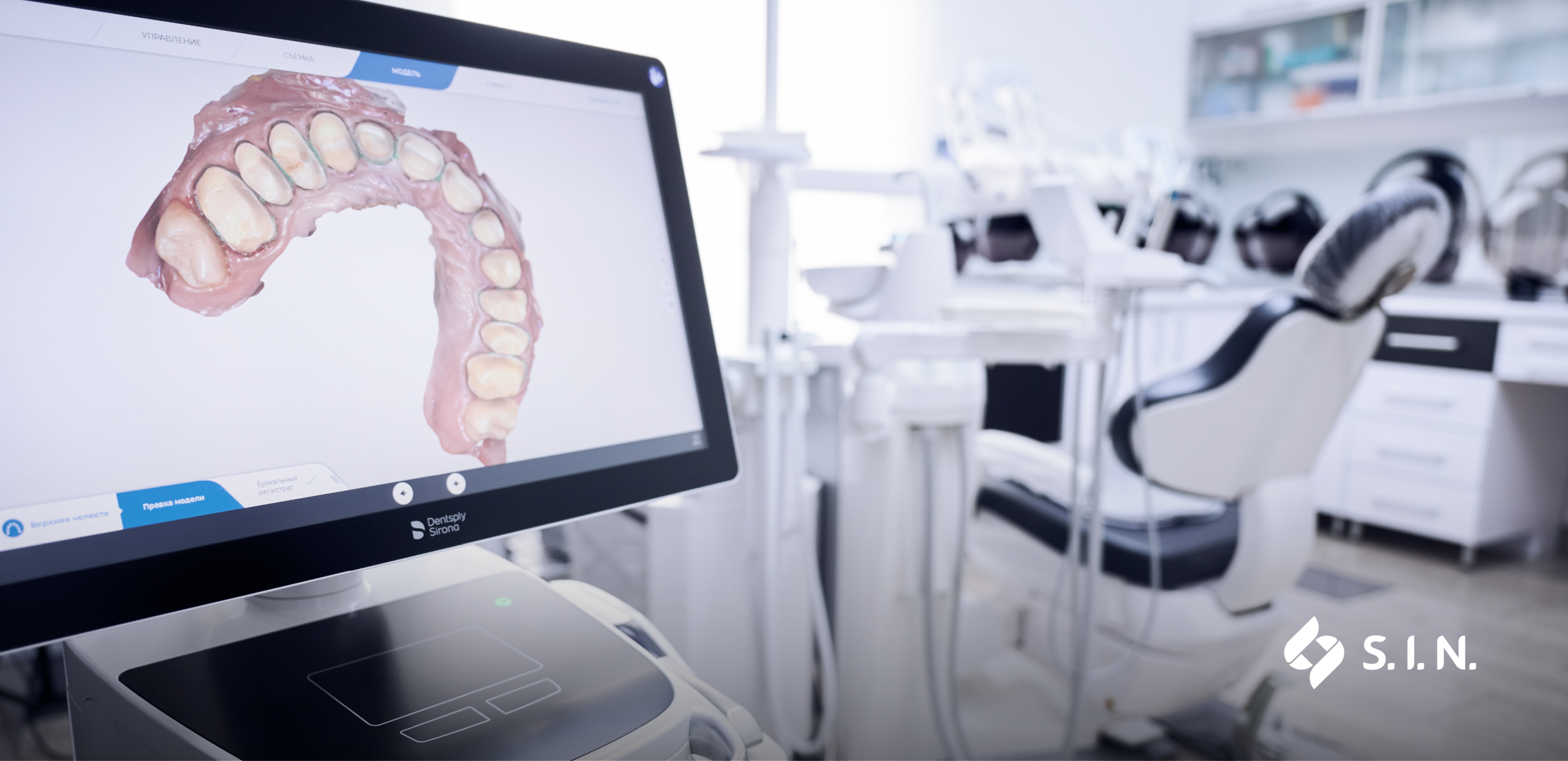
The success of a dental treatment doesn’t rely solely on accurate diagnoses or refined surgical techniques. Ultimately, the patient’s perception and comfort during their appointment play a fundamental role. In this scenario, intraoral scanning emerges as a game-changer in dental routines, replacing uncomfortable procedures with a modern, digital experience.
Not surprisingly, driven by this constant search for clinical predictability, the global market for dental scanners has been growing, showing an average Compound Annual Growth Rate (CAGR) of 12.4% per year expected between 2025 and 2035.
During the initial consultation, transitioning from an analog to a digital workflow can feel challenging. Switching away from conventional procedures often raises the question: Is intraoral scanning worth it? The answer is overwhelmingly positive, as this technology elevates the standard of care and transforms the journey of anyone sitting in the Dentist’s chair.
The end of conventional impressions: greater comfort and speed
Can you count how many times you’ve told a Patient, “It’s uncomfortable, but it’ll be quick!” while taking physical impressions? For many, conventional impressions are the most unpleasant part of treatment. Using physical impression trays with alginate or silicone frequently causes discomfort, gagging, and anxiety.
Now, with a modern dental scanner, that reality changes completely. The digital capture process is entirely clean, fast, and non-invasive. In just a few minutes, an ergonomic tip captures thousands of images per second, generating a realistic 3D model on the computer screen.
Moreover, Patients can take a break whenever they need to. The procedure can be paused and resumed from the exact same point without losing data or having to start over from scratch. It is a process that promises to permanently transform the Patient experience in dental practices.
Read also: The power of sharp thread design in primary stability: the science behind Epikut
Millimetric precision and predictable results
Beyond revolutionizing Patient comfort, digital scanning eliminates common issues associated with traditional materials, such as air bubbles, tearing, or distortions during plaster pouring. The result is a superior level of precision across various specialties:
- Implantology: enhances surgical guide planning and the passive fit of implant-supported prostheses;
- Orthodontics: enables digital simulations of tooth alignment and better-fitting aligners;
- Prosthetics and aesthetics: allows for the detailed design of veneers, laminates, and crowns with excellent marginal fit.
Confidence in this technology is exceptionally high. According to a global industry survey conducted by the Institute of Digital Dentistry (iDD), 81.9% of Dentists state that intraoral scanners are more precise than traditional impressions.
Consequently, this drastically reduces the need for relining or adjustment appointments, increasing treatment predictability while saving valuable time for both the Dentist and the Patient.
Streamlined workflow and transparent communication
Adopting intraoral scanning optimizes your clinical routine from end to end. Digital files — in STL or PLY formats — are sent instantly to the laboratory via the cloud, eliminating physical shipping delays and transit costs. As a result, total production time is reduced, accelerating the delivery of prosthetic pieces.
It’s also worth noting the advantages in visual communication. By viewing their own mouth in a 3D color model on screen, Patients easily understand their oral health condition and proposed treatment plan. This transparency builds trust, improves treatment plan acceptance, and strengthens the perceived value of your services.
Investing in clinic digitization goes beyond simply upgrading machinery — it is about placing Patient satisfaction and peace of mind at the center of all clinical planning.
Keep improving your patients’ experiences and stay up to date with our articles.
Key takeaways recap
1. How does intraoral scanning replace conventional impressions and improve Patient comfort?
It eliminates the need for physical trays filled with alginate or silicone — which often trigger anxiety and gagging — replacing them with a quick, clean, and ergonomic optical scan. It also allows the clinician to pause and resume capture at any moment without losing saved data.
2. What does research say about the precision of a dental scanner compared to traditional methods?
According to a global study by the Institute of Digital Dentistry (iDD), 81.9% of Dentists agree that intraoral scanners offer greater precision than conventional impressions by eliminating bubbles, tears, and plaster expansion distortions.
3. How does cloud file transmission optimize clinic workflow?
By exporting digital data in STL or PLY formats via the cloud, files reach the prosthetic lab in seconds. This eliminates the cost and transit time of shipping physical stone models, shortening overall production times and speeding up final delivery to the Patient.
4. How does seeing a 3D model on screen influence treatment acceptance?
Viewing their own mouth in a detailed, full-color 3D image makes diagnosis visual and intuitive for the Patient. They gain a clearer understanding of their oral condition and the necessity of the proposed treatment, which builds trust in the practitioner’s approach and boosts case acceptance.